
Starting a new business is exciting, but excitement alone is not enough to make a business idea successful. Before investing money, hiring employees, finding a location, purchasing equipment, or launching a marketing campaign, it is important to understand whether the idea actually makes business sense. This is where a Feasibility Study becomes valuable.
A feasibility study helps entrepreneurs, investors, and companies answer one of the most important questions before starting a new venture:
Is this business idea practical, financially viable, and worth pursuing?
Rather than relying on assumptions, a well-prepared feasibility study looks at the market, customers, competitors, operations, costs, revenue potential, risks, and investment requirements.
It does not guarantee that a business will succeed. Instead, it gives decision-makers a clearer picture of the opportunity and the challenges they may face.
In this guide, we explain what a feasibility study is, what it normally includes, why it matters, and how businesses can use it before committing significant resources.
What Is a Feasibility Study?
A Feasibility Study is a detailed assessment carried out to determine whether a proposed business, project, product, or investment is practical and commercially viable.
The study brings together different areas of analysis to evaluate the overall opportunity.
Depending on the type of business, a feasibility study may examine:
- Market demand
- Target customers
- Competitors
- Location
- Products or services
- Pricing
- Revenue potential
- Startup and operating costs
- Staffing requirements
- Equipment and technology
- Regulations
- Funding requirements
- Potential risks
- Expected returns
The purpose is not simply to create a long report.
The real purpose is to provide enough reliable information for an entrepreneur or investor to make a more informed decision.
For example, someone may have a strong idea for opening a restaurant in a particular location. The concept may look attractive, but a proper study might reveal high rental costs, limited parking, intense competition, or insufficient demand from the target customer group.
Finding these issues before investing can save a business from making an expensive mistake.
Why Is a Feasibility Study Important?
Starting a business involves uncertainty.
Even businesses operating in growing industries can fail because the location is wrong, pricing is unrealistic, costs are underestimated, or the target customers are not as interested as expected.
A feasibility study helps reduce some of this uncertainty.
It Tests the Business Idea
An entrepreneur may believe a product or service will be successful. Research allows that assumption to be tested against actual market conditions.
It Helps Estimate Financial Requirements
Many businesses fail to plan for the full cost of starting and operating a business.
A feasibility study can help estimate capital expenditure, working capital, operating expenses, staffing costs, marketing expenses, and other financial requirements.
It Identifies Potential Risks
Every business has risks. Identifying them early gives management an opportunity to develop strategies to reduce or manage them.
It Supports Investment Decisions
Investors and lenders usually want to understand the commercial potential of a project before committing capital.
A well-prepared study can provide a structured basis for evaluating the opportunity.
It Supports Better Planning
A feasibility study can also help entrepreneurs move from a general business idea toward a more practical operating plan.
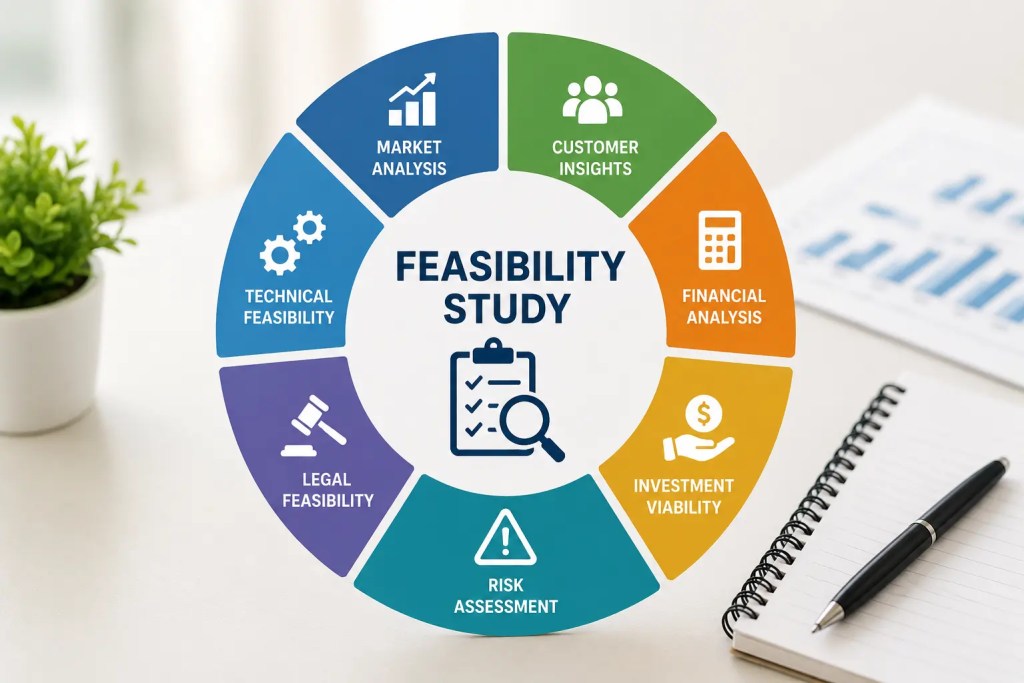
What Does a Feasibility Study Include?
There is no single format that works for every business. The contents should depend on the type, size, location, and purpose of the proposed venture.
However, a comprehensive study usually covers several important areas.
1. Market Feasibility Analysis
A Market feasibility analysis examines whether there is sufficient demand for the proposed product or service.
This is one of the most important parts of a feasibility study because a business cannot survive without customers.
Market research may examine:
- Market size
- Market growth
- Target customers
- Customer needs
- Buying behavior
- Competitors
- Pricing
- Market trends
- Demand patterns
- Potential market share
For example, opening a premium fitness center may appear attractive in a growing city. But the real opportunity depends on factors such as the number of potential customers, household income, existing fitness centers, competitor pricing, location, and consumer preferences.
A market feasibility analysis brings these factors together.
2. Customer and Target Market Analysis
Knowing the overall market is not enough.
A business also needs to understand who is most likely to buy.
The target audience can be analyzed based on factors such as:
- Age
- Income
- Location
- Occupation
- Lifestyle
- Purchasing habits
- Business size
- Industry
- Specific customer needs
For a B2B business, the analysis may focus on company size, industry, decision-makers, purchasing processes, and budgets.
The more clearly a business understands its target customer, the easier it becomes to develop the right product, pricing, marketing, and sales strategy.
3. Competitor Analysis
Customers usually have alternatives.
A feasibility study should therefore examine both direct and indirect competitors.
Competitor analysis may include:
- Number of competitors
- Products and services
- Pricing
- Market positioning
- Strengths and weaknesses
- Locations
- Customer segments
- Marketing strategies
- Competitive advantages
The objective is not simply to make a list of competitors.
The more useful question is:
Why would customers choose this new business instead of an existing alternative?
If the answer is unclear, the business concept may need to be adjusted.
4. Technical and Operational Feasibility
A business idea may look commercially attractive but still be difficult to operate.
Technical and operational feasibility examines whether the business can actually deliver its products or services effectively.
Depending on the business, this may include:
- Location requirements
- Equipment
- Technology
- Production capacity
- Suppliers
- Logistics
- Staffing
- Operating processes
- Infrastructure
- Quality requirements
For example, a manufacturing project may require specialized machinery, reliable raw materials, skilled workers, sufficient power supply, storage, and transportation.
If any of these elements are unavailable or too expensive, the project may not be practical in its proposed form.
5. Financial Feasibility
Financial feasibility is often one of the areas investors pay the closest attention to.
A financial assessment may include:
- Initial investment
- Capital expenditure
- Working capital
- Operating expenses
- Revenue projections
- Gross margins
- Cash flow
- Break-even analysis
- Profitability
- Funding requirements
- Potential return on investment
Financial projections should be based on reasonable assumptions rather than overly optimistic expectations.
For example, projecting that a new business will immediately achieve high sales without considering customer acquisition time can make the financial model misleading.
A good financial model should consider different scenarios, including realistic, optimistic, and conservative outcomes.
6. Investment Feasibility Study
An Investment feasibility study looks more closely at whether an opportunity makes financial and commercial sense for an investor.
This can be particularly useful for larger projects involving significant capital.
An investment feasibility assessment may consider:
- Total investment required
- Funding structure
- Expected revenues
- Operating costs
- Profitability
- Cash flow
- Investment returns
- Payback period
- Key risks
- Exit considerations
Investors are generally interested in more than the potential revenue.
They want to understand how much capital is required, how the business is expected to perform, what could go wrong, and whether the expected returns justify the risks.
7. Legal and Regulatory Feasibility
Legal requirements can have a major impact on whether a business can operate.
Depending on the industry and location, a feasibility study may need to consider:
- Business registration
- Licenses
- Permits
- Zoning
- Industry regulations
- Environmental requirements
- Employment regulations
- Tax considerations
- Safety standards
Ignoring regulatory requirements during the early planning stage can create serious problems later.
For this reason, legal and regulatory considerations should be reviewed before making major investments.
8. Risk Assessment
No feasibility study is complete without considering risks.
Potential risks can come from many sources, including:
- Weak market demand
- Strong competition
- Rising costs
- Supply chain problems
- Regulatory changes
- Technology changes
- Economic conditions
- Staffing challenges
- Funding shortages
The goal is not to eliminate every risk. That is rarely possible.
Instead, the objective is to understand the major risks and consider how they can be managed.
Project Feasibility vs Business Feasibility
The terms Project feasibility and business feasibility are sometimes used interchangeably, but they can have different applications.
Project feasibility often focuses on whether a specific project can be successfully implemented.
For example:
- A new hotel development
- A manufacturing facility
- A retail center
- A renewable energy project
- A technology implementation
- A commercial property development
A broader business feasibility study may evaluate the entire business model, including the market, customers, operations, financial performance, and long-term sustainability.
The exact scope depends on the decision that needs to be made.
What Is a Startup Feasibility Study?
A Startup feasibility study is designed specifically for a new business or early-stage venture.
New businesses face a particularly high level of uncertainty because they may have limited customer history, limited financial resources, and little established market presence.
A startup feasibility assessment can help answer questions such as:
- Is there a real market for the product?
- Who are the likely customers?
- How strong is the competition?
- How much money is needed to launch?
- How long could it take to reach break-even?
- What resources are required?
- What are the major risks?
- Is the business model sustainable?
For startups, this process can be especially useful before raising external funding or making significant personal investments.
Feasibility Study vs Business Plan
A feasibility study and a business plan are related, but they are not the same thing.
A feasibility study asks whether the business idea is worth pursuing.
A business plan explains how the business intends to operate and grow.
In simple terms:
Feasibility Study → Should we do it?
Business Plan → How will we do it?
It is often more sensible to conduct feasibility work before investing significant time in developing a detailed business plan.
If the research shows that the concept is not commercially viable, the entrepreneur can make changes before committing substantial resources.
Common Mistakes to Avoid
A feasibility study is only useful when the information and assumptions behind it are reasonable.
Some common mistakes include:
Overestimating Demand
Entrepreneurs sometimes assume that because they personally like an idea, customers will automatically buy it.
Demand should be tested objectively.
Underestimating Costs
Startup costs are often easier to identify than ongoing costs. Rent, salaries, maintenance, marketing, utilities, insurance, and working capital can have a major impact on profitability.
Ignoring Competition
Even if there is strong demand, competitors may already serve the market effectively.
Using Unrealistic Financial Projections
Financial projections should be supported by market evidence and clearly stated assumptions.
Treating the Study as a Guarantee
A feasibility study cannot predict the future with certainty.
Markets change, competitors respond, customer preferences evolve, and unexpected events happen.
The purpose is to improve decision-making, not promise success.
When Should You Conduct a Feasibility Study?
A feasibility study is particularly useful before:
- Starting a new business
- Launching a new product
- Entering a new market
- Opening a new location
- Developing a major project
- Making a large investment
- Expanding an existing business
- Seeking funding
- Acquiring or developing commercial property
The earlier major problems are identified, the easier and less expensive it can be to change the concept.
How MSSPL Global Can Help
For businesses and investors that need professional support before making a major investment decision, MSSPL Global provides feasibility and business consulting services.
Its feasibility study services can help assess areas such as market opportunity, competition, location, concept viability, financial projections, operating requirements, and potential risks.
Businesses can learn more about MSSPL Global and its services at https://mssplglobal.com/.
Professional feasibility work can be particularly valuable when a project involves substantial capital or when the business owner needs an independent assessment rather than relying only on internal assumptions.
Frequently Asked Questions
What is a Feasibility Study in business?
A Feasibility Study is a structured assessment used to determine whether a proposed business, project, product, or investment is practical and commercially viable. It normally considers market demand, competition, operations, financial requirements, risks, and other relevant factors.
Is a feasibility study necessary before starting a business?
It is not legally required for every business, but it can be extremely useful, especially when the business requires significant investment. It helps entrepreneurs identify potential problems and evaluate the opportunity before committing substantial resources.
How long does a feasibility study take?
The timeline depends on the size and complexity of the project. A small business assessment may take relatively little time, while a large investment or development project can require several weeks or longer because of the amount of market, operational, and financial research involved.
What is a Business feasibility study?
A Business feasibility study evaluates whether a proposed business model is commercially practical. It can examine the target market, competition, operations, financial projections, investment requirements, and potential risks.
What is Market feasibility analysis?
Market feasibility analysis examines whether there is sufficient demand and commercial opportunity for a proposed product, service, or business. It usually considers customers, competitors, market size, trends, pricing, and potential demand.
What is an Investment feasibility study?
An Investment feasibility study evaluates whether a proposed investment is financially and commercially attractive. It can include investment requirements, revenue projections, operating costs, profitability, cash flow, returns, and risks.
What does Project feasibility mean?
Project feasibility refers to assessing whether a particular project can realistically be implemented and completed successfully. It can include technical, operational, financial, market, legal, and scheduling considerations.
What is Startup feasibility?
Startup feasibility evaluates whether a new business idea has enough market potential, operational practicality, financial viability, and resources to justify moving forward.
Can a feasibility study guarantee business success?
No. A feasibility study cannot guarantee success because market conditions and business circumstances can change. Its purpose is to reduce uncertainty and provide better evidence for making a decision.
Conclusion
Starting a business without understanding the market, costs, competition, and risks can be an expensive gamble.
A Feasibility Study gives entrepreneurs and investors an opportunity to step back and examine the business idea before putting significant money and resources into it.
A good study does more than calculate potential profits. It asks whether customers actually need the product, whether the market is attractive, whether the business can compete, whether the operation is practical, how much investment is required, and what could prevent the project from succeeding.
From Market feasibility analysis and competitor research to financial projections, operational planning, regulatory considerations, and risk assessment, each part contributes to a clearer picture of the opportunity.
For startups, a Startup feasibility assessment can help turn an initial idea into a more informed investment decision. For established companies, Project feasibility and investment analysis can help determine whether an expansion, new location, development, or major project is worth pursuing.
The most important thing to remember is that a feasibility study is not about proving that an idea will succeed. It is about finding out whether the idea makes sense before you spend too much time and money trying to make it work.
When the research shows a strong opportunity, the business can move forward with greater confidence. When it reveals problems, the entrepreneur has an opportunity to modify the concept, change the strategy, reduce the investment, or decide not to proceed.
That is the real value of a feasibility study: better information before a major business decision.
For professional feasibility studies and business consulting support, visit MSSPL Global at https://mssplglobal.com/.

